How to Build a Digital Marketing Strategy from Scratch: The Complete 2026 Guide for Small Businesses
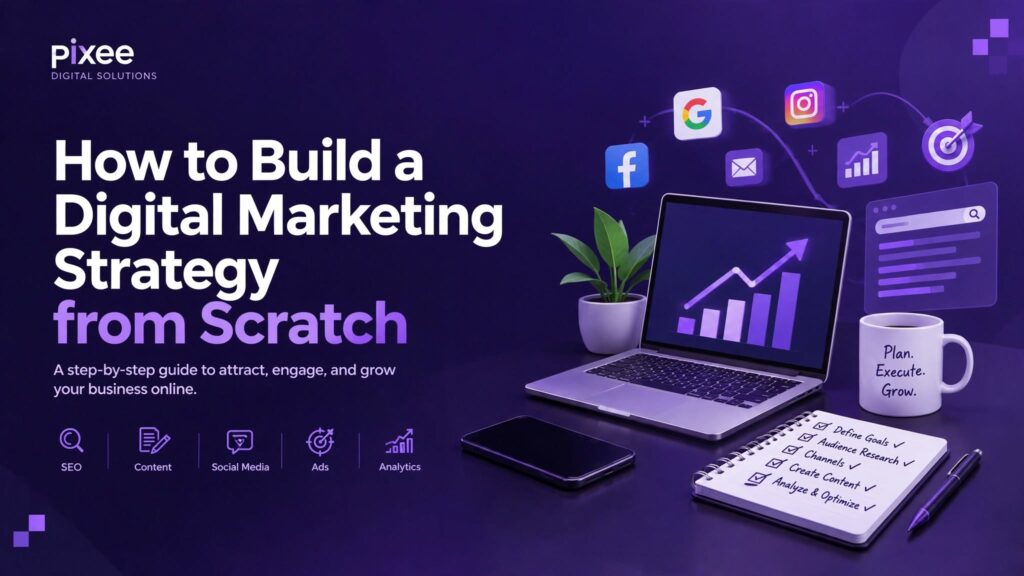
Starting digital marketing from zero can feel like shouting into the void. You have a good business, but no traffic, no leads, and no idea where to put your limited time and money.
You don’t need a big budget. You need a system.
After helping 100+ small businesses build their presence from scratch at Pixee, here’s the exact 7-step framework we use that actually works in 2026 – built on EEAT (Experience, Expertise, Authoritativeness, Trustworthiness).
Step 1: Get Clarity Before You Create Anything
Most businesses start by posting. Smart businesses start by defining.
Answer these 3 questions on one page:
1. Who is your ONE ideal customer? Not “everyone in Calicut.” Be specific: “Owners of beauty salons in Kerala with 3-10 staff who want to get more bookings from Instagram.”
2. What is the ONE painful problem you solve? Not “digital marketing.” Instead, “We help salons turn Instagram followers into confirmed appointments without spending lakhs on ads.”
3. Why should they trust YOU? This is your EEAT foundation. List your real experience – years in the field, number of clients, results, your story. People trust people, not logos.
Write this down. Every piece of content, ad, and page will come from this.
Step 2: Build Your Home Base (Your Website + Google)
Your Instagram is not your home. Instagram can shadowban you. Your website is an asset you own.
What you need on Day 1:
A. A Conversion-Focused Website (Not a Brochure):
- Homepage that says in 5 seconds: What you do, who it’s for, and a proof.
- Service pages with real photos, process, FAQs, and pricing range.
- About page with your face, your story, and your team. This builds Trust.
- Contact page with WhatsApp button, map, and form.
B. Google Business Profile – Your Free Goldmine:
This is where 80% of local leads come from. Optimize it fully:
- Add all services, business hours, and high-quality photos of your work
- Post weekly updates like you do on social media
- Get your first 15 Google reviews and reply to all of them. This is the fastest way to build Authoritativeness.
Install Google Analytics 4, Search Console, and Meta Pixel on day one. If you don’t track, you’re guessing.
Step 3: Choose ONE Traffic Channel to Master
The biggest mistake from scratch: trying to be everywhere.
Pick ONE primary channel based on your customer:
- If your customer searches for you: (e.g., “CA in Calicut”, “best cakes near me”) -> Focus on Google SEO + Google Business Profile
- If your customer discovers you: (e.g., fashion, food, salon, coaching) -> Focus on Instagram + Reels
- If your customer is a business: (B2B services) -> Focus on LinkedIn + Google
Master 1 channel for 90 days. Post 3-4 times a week there. Repurpose that content elsewhere if you have time, but don’t spread thin.
Step 4: Create Content That Proves EEAT, Not Just Fills Feed
In 2026, Google and customers ignore generic content. They reward real experience.
Use our 3-Pillar Content System:
Pillar 1: Expertise – Teach What You Know
Instead of “5 Tips for Digital Marketing,” write “How We Reduced a Boutique’s Ad Cost from ₹150 to ₹23 Per Lead.” Show your process.
Pillar 2: Experience – Show Behind The Scenes
Document, don’t create. Show your workspace, your client calls, your mistakes, your wins. A 15-second video of you explaining a report is more powerful than a Canva quote.
Pillar 3: Trust – Prove Others Trust You
Testimonials with names and faces, case studies with numbers, client video reviews, before/after results, and answers to FAQs. This is what turns a viewer into an enquirer.
Content Rule: 1 long-form piece (blog) per week = 2 short videos + 1 carousel + 1 Google Business post. Work smarter.
Step 5: Build a Simple Funnel That Captures Leads
Traffic without a funnel is wasted.
Don’t send people to your homepage from your bio or ads. Send them to one place with ONE job.
The Simple Small Business Funnel:
Social / Google -> Value Landing Page -> WhatsApp / Lead Form -> Follow-up
Example Offers that work for small businesses:
- Free audit / consultation: “Free 15-min Website Audit”
- Checklist / Template: “Free Content Calendar for Salons”
- WhatsApp Group / Community
Use a tool like Calendly, Tally Forms, or a simple WhatsApp link. Then follow up within 5 minutes. Speed wins.
Step 6: Start Small With Paid Ads (Only After Step 1-5)
Don’t run ads to get a strategy. Run ads to scale a strategy that already has proof.
If you have a landing page that converts and content that people engage with, run this:
Month 1 Budget (₹500/day):
- ₹300/day – Google Search Ads on your main service + city keyword
- ₹200/day – Instagram Retargeting Ads to people who visited your website / Instagram in last 30 days
This captures high-intent people and reminds warm audiences. Never boost random posts.
Step 7: Measure, Review, and Repeat Weekly
Every Monday, check 4 numbers only:
- Traffic: How many website visits from Google / Social?
- Leads: How many enquiries / calls / WhatsApp messages?
- Conversion Rate: Leads divided by Traffic.
- Best Content: Which post/page brought the most leads?
Double down on what worked. Kill what didn’t. Digital marketing is not set-and-forget; it’s test-and-improve.
Your First 30-Day Action Plan:
Week 1: Clarity doc + Website fixes + Google Business Profile setup
Week 2: Write your 4 best FAQs as blog posts + Record 2 short videos
Week 3: Create a simple lead magnet + landing page + WhatsApp automation
Week 4: Start consistent posting on ONE channel + Ask 5 customers for reviews
You don’t need 10 tools. You need consistency for 90 days.
Final Thought
A great digital marketing strategy from scratch isn’t about viral hacks. It’s about being the most helpful and trustworthy answer for your ideal customer in your city.
Focus on real experience, share real expertise, and collect real trust signals. Google calls it EEAT. Your customers just call it “I trust this business.”
If you do this consistently, you won’t just get followers. You’ll get a pipeline.