How to Turn Social Media Followers into Customers
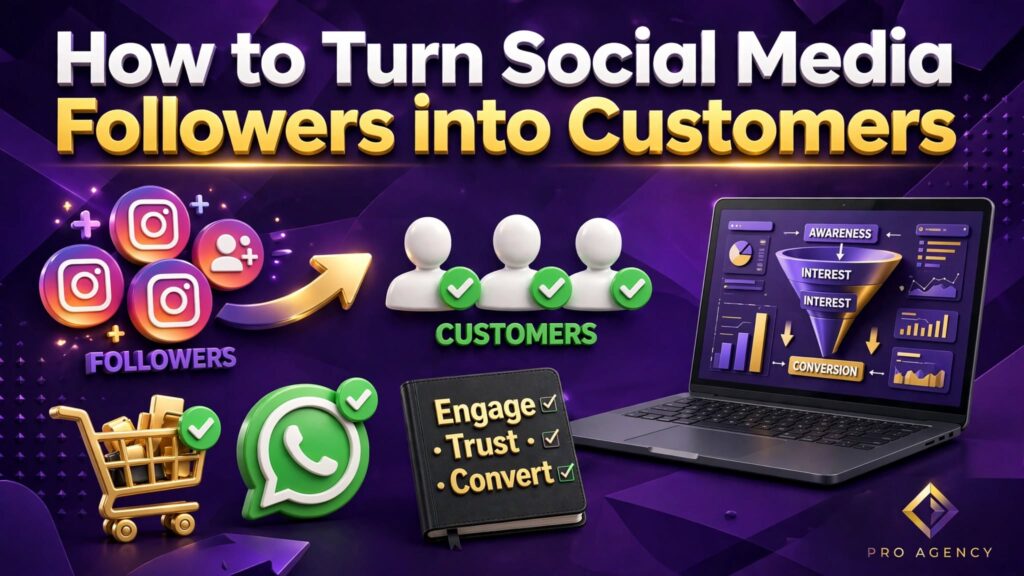
Having thousands of social media followers may look impressive, but followers alone don’t grow a business.
A business can have 10,000 followers and still struggle to generate sales. On the other hand, a smaller account with a highly relevant audience can generate consistent enquiries and customers.
The real value of social media isn’t simply the number of people following your account. It’s your ability to turn attention into trust, trust into conversations, and conversations into customers.
This is where social media marketing becomes more than just posting content.
If your business already has followers but isn’t getting enough enquiries or sales, here are practical ways to turn your social media audience into paying customers.
1. Understand Who Your Followers Are
Before trying to sell anything, understand your audience.
Not every follower is a potential customer.
Some people may follow your account because they like your content. Others may be existing customers, competitors, industry professionals, friends, or people who discovered one particular post.
Your first step should be identifying your ideal customer.
Consider:
- What problem do they have?
- What products or services do they need?
- What motivates them to buy?
- What questions do they ask?
- What objections might stop them from purchasing?
- Which social platforms do they use?
- What type of content do they engage with?
Understanding these factors allows you to create content that speaks directly to people who are more likely to become customers.
2. Stop Making Every Post a Sales Pitch
One of the easiest ways to lose audience attention is to constantly say:
“Buy now.”
“Contact us today.”
“Limited offer.”
Promotional content has a place in social media marketing, but every post shouldn’t feel like an advertisement.
Instead, create a content mix.
For example:
- Educational content — Teach your audience something useful.
- Problem-solving content — Address common customer challenges.
- Entertaining content — Make your brand memorable.
- Trust-building content — Show reviews, results, and experiences.
- Behind-the-scenes content — Humanize your business.
- Promotional content — Present your products or services.
When people consistently receive value from your account, they have more reasons to pay attention when you eventually promote your offer.
3. Build Trust Before Asking for the Sale
People don’t automatically buy because they see a product.
They need confidence in the business behind it.
Social media gives you an opportunity to build that confidence before someone contacts you.
You can demonstrate credibility through:
- Customer testimonials
- Case studies
- Before-and-after examples
- Product demonstrations
- Portfolio work
- Educational videos
- Frequently asked questions
- Team introductions
- Behind-the-scenes content
For service businesses, showing your actual work can be particularly valuable.
Instead of simply saying “We create websites,” show the websites you have created and explain the problem you solved for the client.
Evidence is often more powerful than claims.
4. Create Content Around Customer Problems
Your followers don’t necessarily care about your business as much as they care about solving their own problems.
This is why problem-focused content can be highly effective.
For example, a digital marketing agency could create content such as:
- “Why Your Website Isn’t Generating Leads”
- “5 SEO Mistakes Small Businesses Make”
- “Why Your Facebook Ads Aren’t Converting”
- “How to Improve Your Google Business Profile”
- “What Makes a Business Website Convert?”
These topics attract people who may already be experiencing a problem that your business can solve.
The content provides value first, while naturally introducing your service as a potential solution.
5. Use Strong Calls to Action
A potential customer may be interested in your product but still not know what to do next.
That’s why your social media content should include clear calls to action when appropriate.
Instead of ending a post with nothing, tell people what the next step is.
Examples include:
- Send us a message
- Get a free consultation
- Visit our website
- Request a quote
- Book a call
- WhatsApp us
- Explore our services
- Download the guide
- Shop now
Your CTA should match the purpose of the content.
An educational post may encourage people to save or share it, while a service-focused post may encourage them to enquire.
6. Optimize Your Social Media Profile
Your social media profile is often the first place a potential customer goes after discovering your content.
Make sure someone can understand your business within a few seconds.
Your profile should clearly communicate:
What do you do?
Who do you help?
Where are you located, if relevant?
How can someone contact you?
Your bio should be concise and useful.
Also make sure your profile includes an appropriate website link, contact option, or booking method.
A great social media post can generate interest, but if your profile is confusing, you may lose the opportunity.
7. Make It Easy to Contact You
Every additional step between interest and enquiry creates friction.
If someone wants to contact your business, don’t make them search through multiple pages to find your phone number or email address.
Depending on your business, consider offering:
- Direct messages
- Contact forms
- Phone calls
- Booking links
- Website enquiry forms
Make the next step simple.
For local businesses, clearly displaying location and opening information can also make it easier for potential customers to take action.
8. Use Social Proof
When people are considering a purchase, they often want reassurance that others have had a good experience.
Social proof can help provide that reassurance.
You can showcase:
- Customer reviews
- Testimonials
- Client feedback
- Case studies
- User-generated content
- Project results
- Customer photos
- Product demonstrations
For example, instead of posting:
“Our digital marketing service delivers great results.”
You can share a real client case study explaining the problem, the strategy, the work completed, and measurable outcomes where you have permission and reliable data.
Be accurate and transparent with claims.
9. Use Short-Form Video
Short-form video has become an important format across platforms such as Instagram, Facebook, and YouTube.
Videos can help businesses explain products, demonstrate services, answer questions, and show personality.
You don’t always need expensive production.
Simple videos can include:
- Quick tips
- Tutorials
- FAQs
- Product demonstrations
- Behind-the-scenes clips
- Customer stories
- Common mistakes
- Industry insights
The focus should be on clarity and relevance rather than simply creating videos because video is popular.
10. Retarget Interested Audiences
Not everyone who visits your website or interacts with your social media content will purchase immediately.
Retargeting can help businesses reconnect with people who have previously interacted with their digital presence, depending on platform capabilities and applicable privacy requirements.
For example, a potential customer may:
See your Instagram post → Visit your website → Leave without contacting you.
A suitable retargeting campaign can potentially bring that person back to your website.
This is especially useful when customers need multiple interactions before making a purchasing decision.
11. Create an Offer That Gives People a Reason to Act
Sometimes your audience is interested but doesn’t have enough motivation to take the next step.
A relevant offer can help.
Depending on your business, this could be:
- Free consultation
- Free audit
- First-order incentive
- Limited-time package
- Free delivery
- Bonus service
- Product bundle
- Trial experience
The offer should make sense for your business and customer.
Avoid creating artificial urgency or misleading promotions just to force a sale.
12. Track More Than Likes and Followers
Likes and follower counts can be useful indicators of engagement, but they don’t tell the complete story.
If your goal is customer acquisition, track metrics closer to the business outcome.
For example:
- Profile visits
- Website clicks
- Enquiries
- Leads
- Conversion rate
- Cost per lead
- Sales
- Revenue
- Customer acquisition cost
Imagine two posts.
Post A: 20,000 views and 500 likes but no enquiries.
Post B: 5,000 views and 40 enquiries.
If your objective is generating customers, the second post may provide more useful business value even though it has fewer views.
This is why social media performance should ultimately be connected to business goals.
The Social Media Customer Journey
Turning followers into customers rarely happens in one step.
A typical journey might look like:
Content → Interest → Profile Visit → Website → Trust → Enquiry → Follow-Up → Purchase
Each stage matters.
Your content gets attention.
Your profile communicates your offer.
Your website provides more information.
Reviews and case studies build confidence.
Your CTA encourages action.
Your sales process converts the enquiry.
If one part of the journey is weak, the entire process can suffer.
Final Thoughts
Social media followers are not automatically customers.
To turn followers into customers, businesses need to combine valuable content, trust, clear messaging, strong calls to action, social proof, easy communication, and consistent follow-up.
Don’t focus only on growing your follower count.
Focus on building an audience that is relevant to your business and creating a journey that makes it easy for interested people to become customers.
The goal isn’t simply to get more followers.
The goal is to turn attention into meaningful business results.
Ready to Turn Your Social Media Into a Growth Channel?
At Pixee Digital Solutions, we help businesses use social media as more than just a place to post content.
Our digital marketing solutions include social media marketing, SEO, paid advertising, website development, content creation, branding, and digital strategy designed around your business objectives.
Whether you need to build your audience, improve engagement, generate enquiries, or create a stronger digital presence, we can help you develop a strategy that connects your social media activity with real business goals.
Your followers are already paying attention. Now give them a reason to take the next step.
Ready to turn followers into customers?
Get in touch with Pixee Digital Solutions today and let’s build a social media strategy focused on turning attention into growth.